In Math Workshop, we have been been studying area models of fractions. Through homework, we have also been reviewing fraction concepts using linear models and set models (groups of objects). All of these models are important in helping to develop conceptual understanding of fractions.
The links below are helpful in reviewing some of the "big ideas" we have been studying in class. Use them to review and clarify your understanding of fractions. :-)
What are fractions?
Fractions
How can you make and identify equivalent fractions?
Equivalent Fractions
How do you find the "Greatest Common Factor" to put a fraction in lowest terms?
Greatest Common Factor
:-) Enjoy.
Students, leave a comment to share your thoughts on these Study Jams.

Tuesday, January 27, 2015

Sunday, December 28, 2014
Multicultural Luncheon, Crafts/Activities, & St. Augustine Field Study~ OH MY!


Wednesday, December 10, 2014
Innovative Instruments
Wow! The home-made instruments that our students created to culminate our study of Sound Energy are amazing!! Such a variety, from percussion creations to string and wind instruments~ and all using such creative materials from around the students' homes. :-)
Today in class, each student shared his or her instrument and explained how to change the pitch (if possible) and the loudness. Group photos and very brief video clips were then collected to capture the precious moments. Check them out here!


Saturday, December 6, 2014
Partial Quotients
Some of you have been wondering about the Partial Quotients method for solving division problems (also known as Russian Peasant).
This method is important because it draws upon important ideas in multiplication (the inverse operation of division). Did you know that multiplication is also referred to as "repeated" addition? Well, division is also referred to as "repeated" subtraction.


This method is important because it draws upon important ideas in multiplication (the inverse operation of division). Did you know that multiplication is also referred to as "repeated" addition? Well, division is also referred to as "repeated" subtraction.

635 is the DIVIDEND of a division problem. It represents the TOTAL.

15 is the DIVISOR.
In this division problem, the question we are trying to answer is "How many groups of 15 are in 635?"
This leads us to think of multiplication to help us find the number of groups of 15 that can be made with a total of 635. Since division is repeated subtraction, we must subtract away groups of 15 until we no longer have enough left to make another group of 15.
A brainstorming process happens next. Because 635, is so much more than 15, we don't want to take away only a few groups of 15 at a time. The goal is to work as efficiently as possible.
We know that 1 x 15 is equal to 15, therefore 10 groups of 15 (10 x 15) is equal to 150. Working with landmark multiples of 10 (10, 20, 30, 40) is important and is built from our knowledge of basic multiplication facts.

Notice that this brainstorming process has helped to determine that 40 groups of 15 is equal to 600. (This is close to our total of 635.) Using this problem helps us to "take away" (repeated subtraction) 40 groups of 15 from the 635 total, and this leaves only a difference of 35.
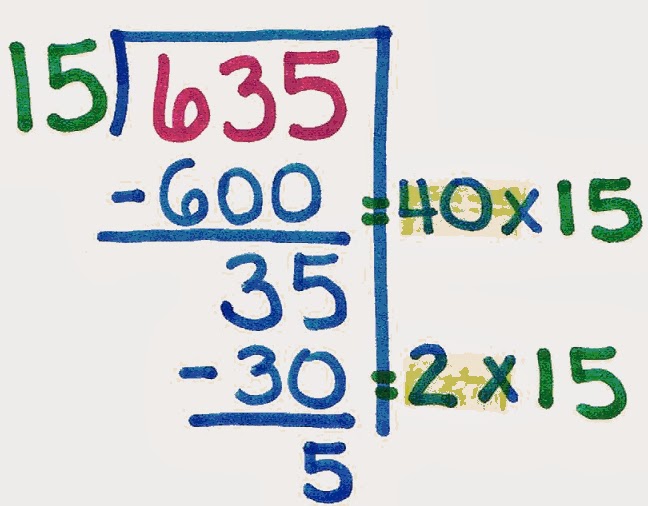
Then, taking away another 2 groups of 15 (2 x 15), leaves a final difference of 5 (which is the "remainder" as 5 is not enough to make another group of 15).

This work shows that 42 groups of 15 can be made (or subtracted away) from 635 and that there will be 5 left over. It is very helpful to represent this remainder as a fraction since we are left with "part" of a new group of 15 and the fraction helps us to understand that this is what the remainder (left-over) means.

42 groups of 15 were made and we have "5/15" or "1/3" of a another group.
The above example has shown the most efficient way to subtract groups of 15 (40 groups and then 2 groups), however, students may solve this problem in many different ways. Below shows another example of how the Partial Quotients method might be used to solve this same problem.
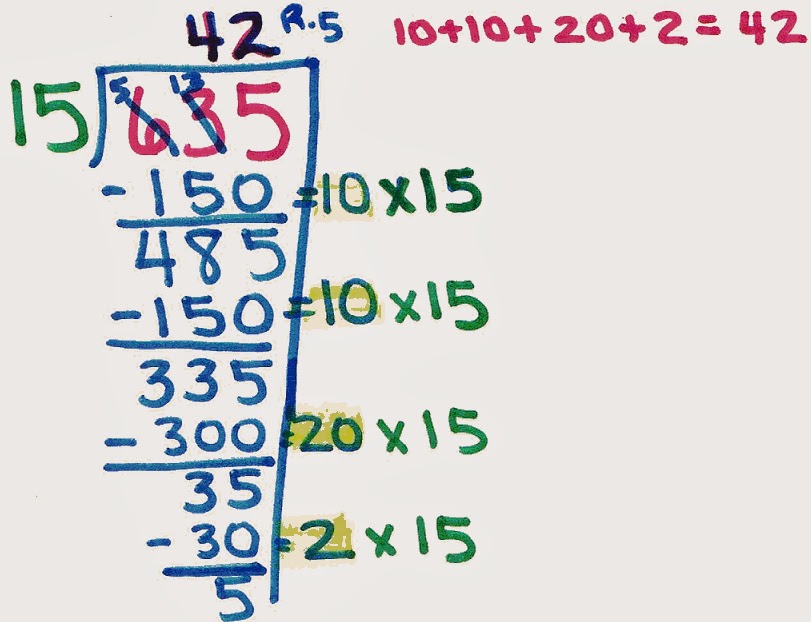
You will notice that 42 groups of 15 were still subtracted, but the process occurred in four steps instead of two steps.
In addition to this strategy, there are other division strategies students use to solve division problems. Page 9 in the student planners highlight a few of these strategies (such as use of a multiple tower or ratio table/skip counting).
This Partial Quotients method will be a preferred method as we progress through the 4th grade as it connects with the traditional algorithm for division, which is a major focus in 5th grade.
Happy Mathematizing!
Tuesday, November 25, 2014
We Can Achieve (3000)!!
 This year, readers at Chets Creek have been working hard within the pages of a new-to-us resource, Achieve 3000. With initial placement testing in September, each student's independent reading level has been identified, and the program has been tailored to meet them at their own independent reading levels. Each calendar month, as students read articles and complete comprehension activities success, the program will adjust the difficulty level of their articles up or down, based on their activity scores. In order to make adjustments, the program needs AT LEAST four completed activities for each month. For this reason, our students are participating in a weekly small group rotation schedule in which they complete an Achieve 3000 article and activity in class each week.
In order to provide more reading practice for each student, it is strongly encouraged that they complete at least one article with activity at home each week in place of or in addition to their nightly ELA homework. Each reader has been taught how to dig into the "My Lessons" tab and find articles with activities to complete.

Each student received a copy of the challenge log in class today, but a printable version is also available here. Challenge logs will not be accepted late, so be sure to take care of them!
I can't wait to see how many readers take advantage of this great opportunity! You won't want to miss out on the rewards!

Sunday, November 23, 2014
Two Current Approaches to Multiplication
Our work with multi-digit multiplication has certainly made progress in recent weeks. Below are two common approaches that we have been using in class:


Multiplication Cluster

This strategy of decomposing one of the factors has reinforced the concept of multiplication in that one factor represents the size of groups while the other factor represents the number of groups.
Open Array Model

This model has been fantastic as we have made sense of multiplication with larger factors because it has helped us not lose sight of the value of each factor and it has enabled us to decompose BOTH factors and keep track of finding all of the needed partial products.
Monday, November 17, 2014
Subscribe to:
Posts (Atom)